Generative Engine Optimisation (GEO) is rapidly replacing the traditional SEO content approach. As a result, ranking on Google is not enough. You need AI visibility, and GEO content audits are the most prominent way to do that. Around 65% of organisations now use generative AI, almost double the adoption rate compared to last year [1].
GEO content audits are different from SEO audits. Generative search focuses on how AI models select and present information. They ensure your content is citation-worthy, machine-readable, and structured to appear in AI-summaries. As per studies, about 63% of users now choose AI assistants over traditional search engines for faster answers[2].
A well-executed GEO audit will help you identify gaps in content, technical setup, schema markup, and brand presentation. It will give you a clear roadmap to optimise for AI-driven discovery.
What Is a Generative Engine Optimisation (GEO) Audit?
A GEO content audit examines how a website can appear in AI-powered search results. Its main focus is on how AI engines generate and present answers.
The audit will help check whether your content uses the correct structured data and if the schema markup is properly implemented. It also evaluates how easily AI systems can interpret and understand your content.
A GEO audit reviews site visibility, the tools in use, and the depth of content coverage required for strong search performance.
What Is a Content Audit?
Before starting a content audit, it’s important to understand the process and the value it brings. If audience engagement is low, your first instinct may be to create new content. However, updating and repurposing existing content are usually more impactful.
A content audit, done by content studios like ours, evaluates your content by assessing its health, performance, strengths, and weaknesses. It will identify content that you need to re-optimise and topics that need expansion.
Audits can vary in scope:
- Comprehensive Audits: Cover a year or more of content
- Focused Audits: Target specific assets based on situational or organisational needs
With a proper audit, you can understand your content strategy and make well-thought-out business decisions. It also provides a foundation for blog planning, optimisation, and overall content growth.
How Generative Search Works
Generative search combines traditional search with advanced AI to deliver intuitive, comprehensive results. Instead of listing links, it uses text, images, reasoning, and credible sources to directly address user queries.
Here is how it works:
- Vision Language Models (VLMs) interpret both text and images. It allows users to upload a photo or describe something in words and get relevant results.
- The system gathers information from many sources and summarises it into concise, informative answers.
- Users can ask follow-up questions or request clarifications, creating a dynamic dialogue.
- Results may include images, comparisons, reviews, ratings, and structured summaries, not just text.
GEO Audit Checklist for Content
A GEO content audit ensures your content is discoverable, citation-ready, and AI-friendly. Follow these steps to optimise for generative search:
Check Citation and Snippet Eligibility
- Ensure pages are indexable and not blocked by robots.txt
- Allow snippets to keep content accessible for AI
- Verify canonicals and structured URLs to support AI reading
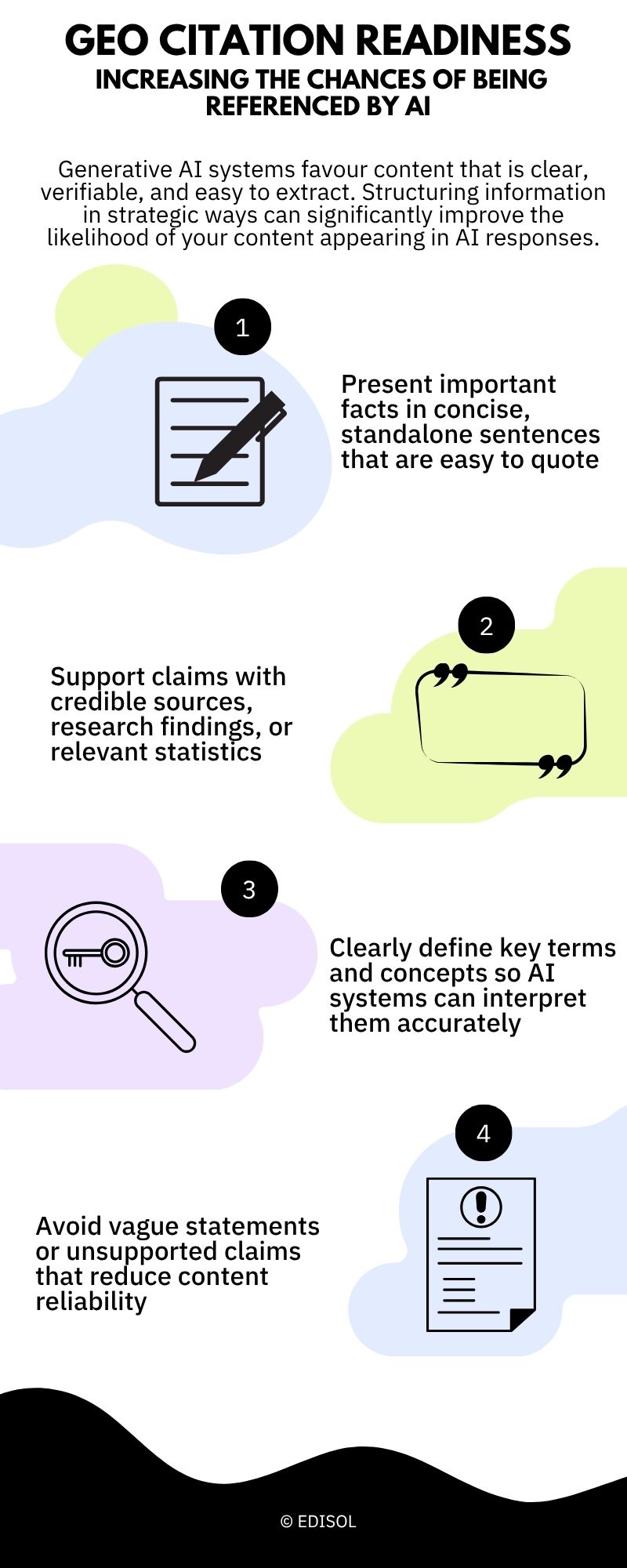
Make Content Citation-Ready
- Lead with short answers, then expand
- Define key terms to make it easier to understand
- Use semantic HTML and keep key facts in text
- Include structured data for organisation, product, blogs, and reviews
- Cite sources and present data clearly to increase chances of being referenced
- Ensure your brand’s visual identity is clearly presented
Demonstrate Expertise and Trustworthiness
- Add author bios and ‘About’ pages with credentials
- Display primary sources, methodologies, or test results
- Maintain accuracy and transparency in all content
- Include a detailed founder profile to strengthen brand credibility
- Incorporate different types of long-form content to boost traffic quality
Enhance Readability and Engagement
- Break content into clear sections with headings and lists
- Use concise, plain language suitable for AI comprehension
- Include summaries and step-by-step explanations where relevant
Monitor and Measure Content Performance
- Track which pages are cited in AI-generated responses
- Maintain a controlled prompt set to monitor citation trends
- Identify gaps and opportunities to expand or re-optimise content
How to Structure Your GEO Audit Checklist
Not all GEO optimisations have equal impact. Structure your GEO audit checklist by balancing potential gains, resources, and urgency. Here is what you need to do to keep everything on track:
- Install high-impact, low-effort fixes like FAQ schema or robots.txt updates to boost immediate AI visibility.
- Focus on topics where competitors already appear in AI responses. Create comprehensive content for these areas.
- Prioritise updating content that already drives traffic or holds strong authority. It’s more likely to be referenced by AI.
- Schedule updates around product launches, events, or seasonal trends to ensure visibility on AI platforms.
- Strengthen your brand’s presence across multiple pages and mentions to improve AI citations.
- Weekly, monthly, quarterly, and yearly. Focus on priority items first, then expand your checklist as your business grows.
Effective vs. Risky Content Patterns for GEO
To succeed in generative search, focus on content that AI systems can easily read, understand, and cite. Here’s a comparison of effective and risky methods:
Effective Content Patterns
- Use short, quotable content blocks that AI systems can easily extract and cite
- Provide clear step-by-step structures for processes and instructions
- Include comparisons and decision criteria to help users evaluate options
- Present evidence, data, and sources to strengthen credibility and trust
Risky Patterns to Avoid
- Publishing AI-powered thin rewrites or mass-produced content with little original value
- Hiding key facts in images, graphics, or collapsible accordions that AI cannot easily read
- Overusing non-snippet formats that prevent content from appearing in AI summaries
- Making claims without supporting evidence or sources
AI is fast becoming the primary search interface, with Gartner predicting that 70% of search traffic will be driven by generative AI by 2028[3]. For an easy GEO content audit framework, start with technical foundations. Optimise your content and then strengthen your brand’s presence across the web. Generative search complements, not replaces, traditional SEO.
To combine the two and get a GEO content audit, talk to experts at Edisol. Our 11-year experience in content marketing and results-driven generative search for clients across domains helps us identify and plug content gaps. Contact Edisol today to optimise your content for AI-powered search.
Frequently Asked Questions
Why are GEO content audits important for modern websites?
As generative search becomes more common, users increasingly rely on AI-generated answers instead of traditional search results. A GEO content audit helps ensure your website content is visible, trustworthy, and structured in a way that AI systems can reference when generating responses.
What elements are typically included in a GEO audit checklist?
A GEO audit checklist often includes content structure, citation readiness, schema markup, author credibility signals, technical accessibility, and brand visibility.
Can existing content be optimised for GEO?
Yes. Many existing SEO-focused pages (blogs or webpages) can be updated to improve GEO performance by adding structured data, clearer definitions, short answer blocks, credible sources, and better content structure. All these strategies help make the information easier for AI systems to cite.
What types of content perform best in generative search?
Content that is structured, factual, and easy to interpret tends to perform best. This includes clear explanations, step-by-step guides, comparisons, research-backed insights, and content that demonstrates expertise and credibility.
References:


