Algorithms and trends play a key role in shaping your brand’s visibility and growth. Understanding how they work helps you reach the right audience and drive meaningful engagement, while ignoring them can limit your impact.
Social media algorithms curate content based on user behaviour, interactions, and preferences, with a growing focus on relevance and engagement. With AI in the mix, these systems have become more predictive. Brands are now analysing content, intent, and tone to determine what matters most to each user.
In fact, platforms like Instagram report that over 90% of users follow at least one business[1]. Algorithm-led discovery now plays a central role in connecting brands with audiences.
How Platform Algorithms Work?
The best way to understand these key algorithms is through exploring how they are used across various social media channels. This reflects the evolution of social media algorithms—from simple feed-based systems to AI-driven models that prioritise relevance, engagement, and user intent. Here are a few of the prominent ones:
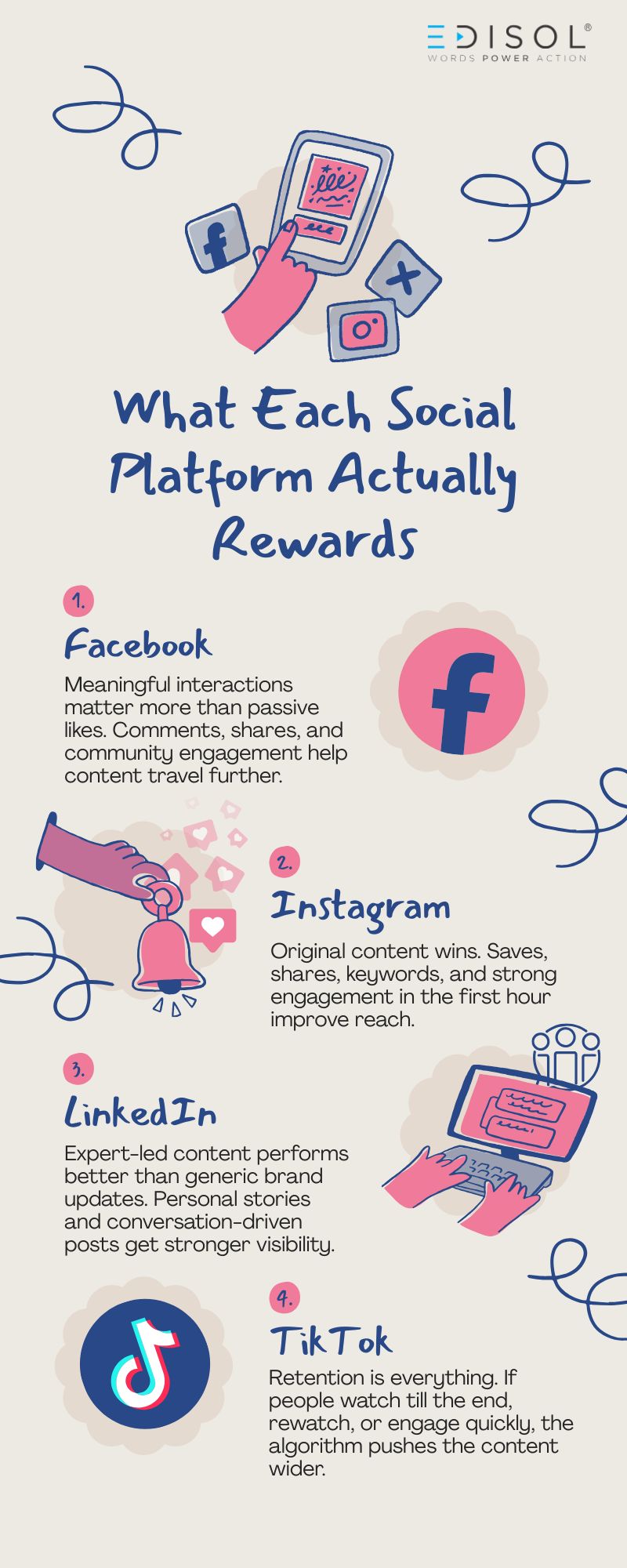
1. Facebook
Facebook applies a four-step algorithm to determine who sees the content.
- Content Library: It is where all the posts can appear in the user’s news feed
- Indicators: Signals such as who posted, the type, when it was posted, and customer interaction
- Forecast: Facebook has an estimation of how each user engages in terms of likes, comments, reshares, and watches
- Ranking: The posts ranked high are shown more often
Facebook Rankings
Facebook's rankings are based on several factors, including:
- Automated Community Moderation
Facebook employs AI to auto-identify non-compliant content and stop its reach
- Content Blurbs
Facebook auto-generates content blurbs that are ranked for credibility and customer engagement
- Community-Centric Discovery
If you are active on Facebook, you can see more content from the same communities
- Connection Signals
Comments and shares from close connections carry more weight
Mastering Facebook Algorithms
Here are a few tips that can help you make the most out of these algorithms on Facebook:
- Boost genuine connections
- Increase engagement signals favoured by the algorithm
- Leverage Facebook-preferred indicators to distribute content types, such as engagement metrics and videos
- Post when your customers are most active
- Respond quickly to queries and comments
2. Instagram
Instagram Explore, Feed, and Reels have ranking systems based on how you use them. Instagram algorithms predict the content you will engage with or the type of content you should engage with next. Understanding them can help to boost your Instagram marketing efforts as a brand or a creator. Take a look below.
Instagram Rankings
Like Facebook, Instagram has its own ranking rules. They depend on:
- Content: Your content score is important. It is calculated via customer engagement, i.e., comments, likes, saves, and shares.
- Format: How formats such as Carousels, Images, Reels, and Stores carry weight.
- Intent Signals: Meta AI forecasts how customer interest changes while using cross-platform behaviour (FB, Threads)
- Sound/music Alignment: LinkedIn original audio to niche trends ranks high
Optimising Instagram Algorithms
Instagram prioritises content that signals relevance, originality, and engagement. To align with these ranking factors, focus on the following:
- Originality
Instagram promotes original content and sharing collaborative content. The handle penalises reposting or duplicated content.
- Engagement
Comments, saves, shares, and DMs are valued more than likes. Your content should attract a comment from your friends.
- SEO
Use targeted keywords in the bio, captions, and image alt-text. This can enhance your search visibility.
- Short-Form
Reels are more popular than static posts. Create 3-5 reels per week, and it has to hook viewers within the first 3 seconds.
- Timelines
Post during peak customer activity time to improve engagement within the first hour.
3. LinkedIn
This platform focuses on building authenticity and content consistency. The LinkedIn algorithm focuses on content matter expertise, customer engagement, and personal storytelling. In fact, 80% of B2B leads from social media come from LinkedIn[2], highlighting the platform’s role in driving high-intent engagement. Every touchpoint works when it comes to the LinkedIn algorithm deciding what earns visibility in customer feeds.
LinkedIn Rankings
LinkedIn evaluates content based on several factors that determine how widely your content is distributed. These include:
- Customer Engagement: Content that sparks a discussion, and comments and shares matter more than likes perform better
- Consistency in Timing: Consistent posting and posts during peak hours enhance visibility
- Niche Posting: Those who post consistently within a specific domain see higher distribution of their content
- Storytelling: Personal stories carry more weight than generic updates or motivational content
- Format and Structure: Carousels, short and digestible posts win in the format section, while long-form posts or external links are better from a structure point of view
Cracking LinkedIn Algorithms
To perform better against these ranking signals, your content strategy should focus on:
- Creating Personal Stories: These story posts drive connection and are better than corporate updates
- Combining Different Formats: A combination of image-led carousels, PDFs, text posts, and videos keeps algorithms and customers engaged
- Keeping it Crisp and Short: Keep your content short and sharp -- Carousels or single-message posts are ideal to deliver value.
- Prompting Conversation: Ask questions and respond to them to keep your post circulating longer.
- Posting During Peak Hours: Post during midday breaks or commute hours when your customers are likely to scroll or engage
- Focusing on Relevance: Focus on one or two core themes for algorithms to see you as a topical expert in your niche
TikTok
TikTok is popular for its content quality, not account size. This means anyone can go viral on the platform. The platform shows users videos based on content that other viewers with similar interests have enjoyed. Around 67% of users[3] say TikTok inspires them to shop even when they weren’t planning to, showing how strongly its algorithm drives discovery.
TikTok Rankings
The following factors shape how TikTok understands your content, predicts user interest, and decides what gets pushed to wider audiences:
- Account and Device Information: The language, location, and device type help in having a fine-tuned performance, though it is not that important
- Customer Interactions: Comments, likes, shares, saves, replays, and watch-through rate help to create prediction models
- Discovery: This behaviour is based on follows and searches, and what the customers are shown
- Watch Time: The first 3 seconds are crucial. The completion rate and rewatch count also carry weight
- Video Content: TikTok categorises the content by topic using caption keywords, hashtags, sounds, effects, and visual content, which is why your brand’s visual identity matters as much as the content you post
Mastering TikTok Algorithms To improve reach, your content should align with the following ranking signals:
- Attention Grabbing
You should be able to hook the viewers in the first few seconds to increase the completion rate.
- Consistency in Posting
TikTok gives importance to consistency in posting. Aim for 1-4 posts a day to stay visible. This helps algorithms with more signals.
- Focused Content
Stick to 1-3 content themes. TikTok’s topic tagging system rewards consistency in the topic.
- Keyword Optimisation
Use searchable phrases in the captions, hashtags, and voiceover. This helps the algorithm match the right customers and amp up your keyword strategy.
- Maximise Viewer Retention
Structure the content in a way to have countdowns, curiosity loops, and payoff at the end.
- Trending Audio and Effects
Use trending audios and effects. TikTok focuses on content that features filters of viral sounds.
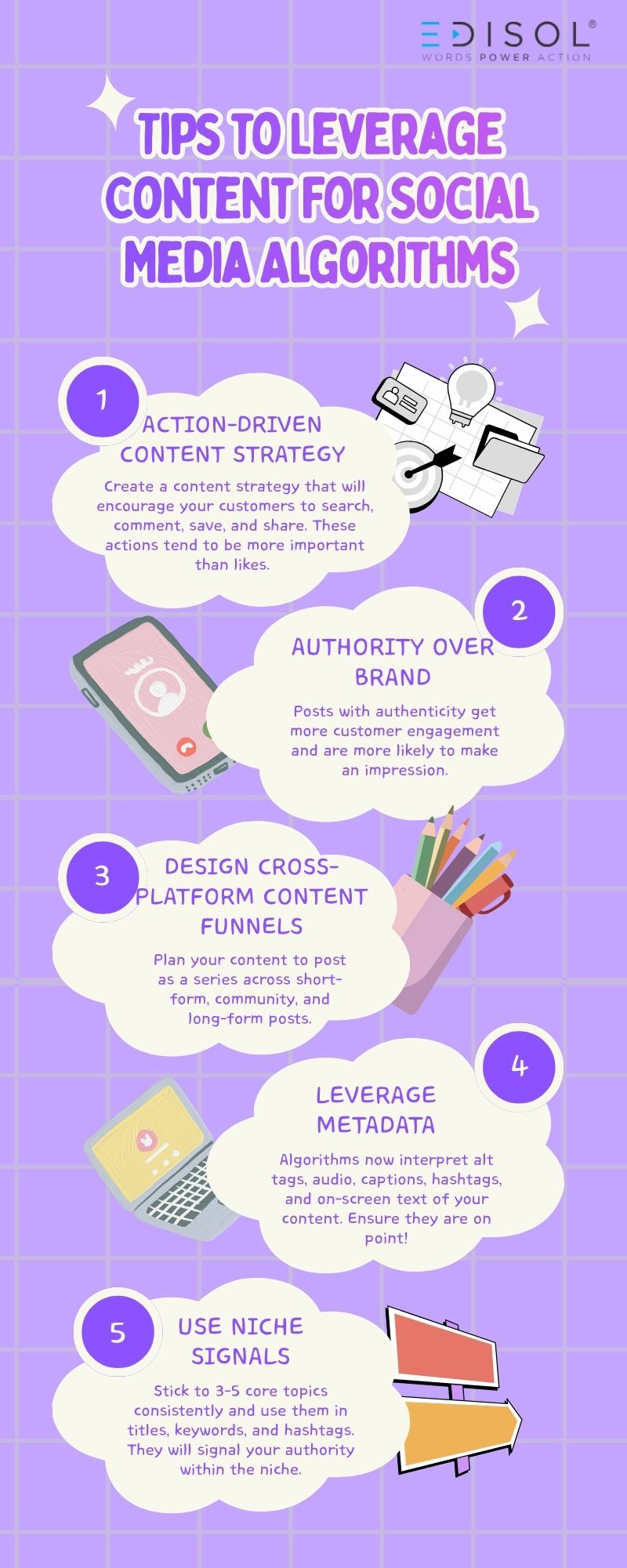
Tips to Leverage Content For Social Media Algorithms
Your content has to resonate with platform-based algorithms, and these strategies will help you to optimise your content for success.
1. Action-Driven Content Strategy
Create a content strategy that will encourage your customers to search, comment, save, and share. These are more important than likes.
2. Authority Over Brand
Posts with authenticity get more customer engagement and are most likely to go viral. Content that reflects a personal voice performs better than that of a brand voice.
3. Design Cross-Platform Content Funnels
Plan your content to post as a series across short-form, community, and long-form posts. TikTok and YouTube algorithms track cross-format movements. This prioritises creators.
4. Leverage Metadata
Algorithms now interpret alt tags, audio, captions, hashtags, and on-screen text of your content. By including relevant keywords in alt text, bios, image captions, and file names, they gain both platform and search engine visibility.
5. Use Niche Signals
Test your content within your niche group or silos before planning to go viral. If there are strong signals, algorithms can decide whether it needs more visibility. If you stick to 3 to 5 core topics consistently and use them in titles, keywords, and hashtags, it will signal your authority within the niche.
Algorithms are changing, and that impacts your social media strategy. At Edisol, we can help you build a meaningful and impactful content-backed strategy to ensure your posts connect with the right customers. Contact our team to know our approach.
Frequently Asked Questions
What is the meaning of algorithms in social media?
On social media, algorithms are ranking systems that decide which posts are shown to whom and in what order. These algorithms depend on signals from when a customer stops scrolling, finishes watching a video, saves it, shares it, or swipes quickly.
What are algorithms used for?
Algorithms and trends are used to make decisions where humans cannot review everything. They decide if a brand’s sponsored post is worth recommending or skipping. What is the purpose of a social media algorithm? The goal of social media algorithms is to deliver content that viewers will enjoy, encouraging them to stay longer and return more often.
Are social media algorithms AI?
Social media platforms use AI to predict what each viewer will do next. The best practices are based on behaviour design.
Will AI keep human marketers out of marketing?
Though AI tools will help marketers in many different ways, human creativity, emotions, and storytelling cannot be replaced.
References
[1] https://www.hubspot.com/instagram-marketing
[2] https://www.linkedin.com/pulse/80-b2b-leads-from-social-media-come-linkedin-luminous-pr-xixje
[3] https://dotdigital.com/blog/tiktok-marketing-for-ecommerce/


