More than 90% of marketers still invest in content marketing[1], aiming to reduce the content depth gap, increase knowledge-sharing, and add value to consumers. In fact, 72% of marketers plan to increase their content-related spending as of 2026[2].
While content can help a brand build awareness, connect with audiences, and generate sustainable growth, AI has changed how we create content. Some people think AI content lacks originality and is ‘slop’. Others see it as a quick and cost-effective way to produce content.
Content volume alone does not drive impact anymore. Without a clear strategy, even frequent publishing can fail to engage users or deliver results. To make content actionable, you need a structured approach.
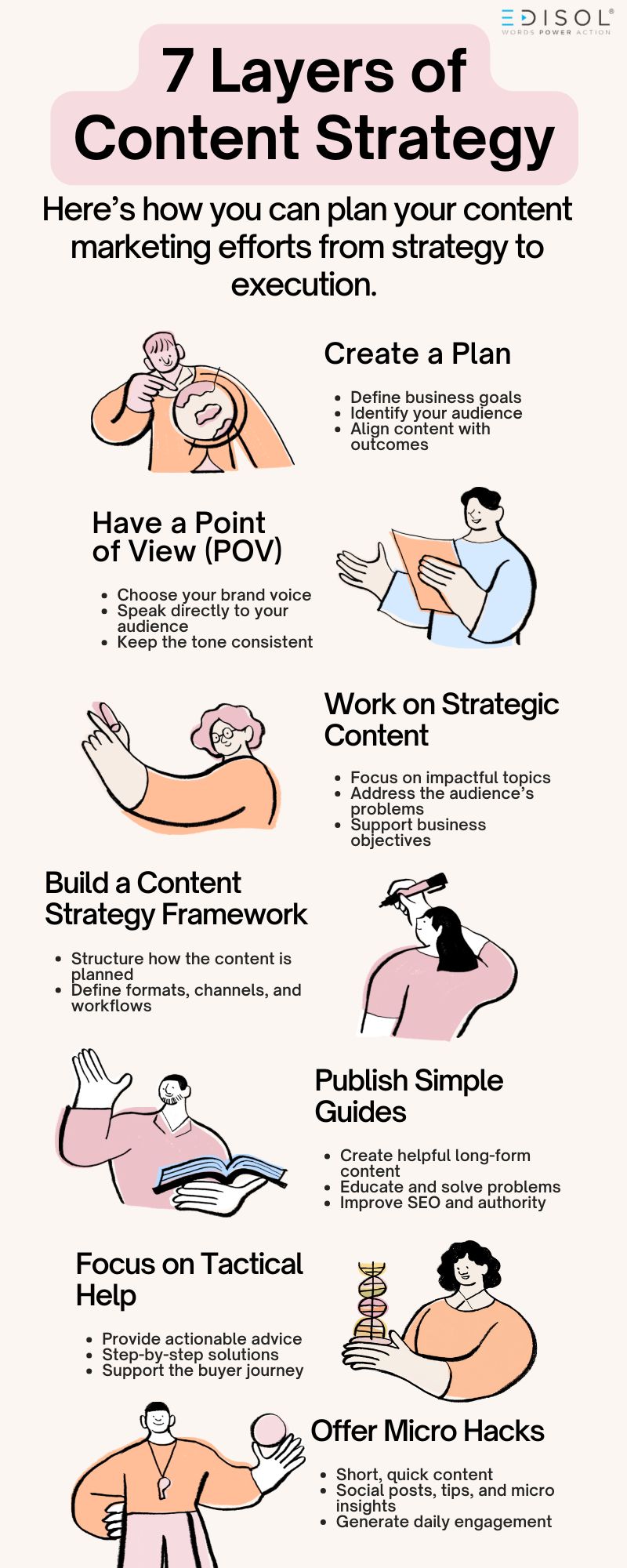
The 7 layers of content strategy help align vision, strategy, and execution, ensuring your content remains relevant, consistent, and outcome-driven.
Content Creation Spectrum
Today, an audience can consume content in formats that suit their preferences – be it TikTok videos, Instagram posts, LinkedIn carousels, YouTube videos, and more, as well as Discord and Substack.
In response, brands typically create content across a spectrum—from highly polished, professionally produced assets to more raw, real-time formats or user-generated content.
Content may also range from AI-generated content to collaborative and fully human-created assets. Brands use content as an asset itself or to support and showcase a product or service.
The spectrum thus covers various levels of quality and formats, be it videos, blogs, guides, ebooks, podcasts, newsletters, vlogs, reels, posts, tweets, and more.
The right mix depends on the audience, platform, and objective. This range of approaches is known as the content creation spectrum. Mixing professional visuals with authentic storytelling is essential, but getting the right balance requires a framework-based content strategy.
The 7 Layers of a High-Impact Content Strategy
Your content strategy sets the roadmap. A content layers framework guides content creation, publishing, and management. Here are the details of each layer:
1. Outcomes
Instead of talking about your product, focus on what your audience can achieve by consuming your content. It's easy to fall into the self-promotion trap as promotional content explains features and services, but forgets the customer’s real problems.
Content centered around outcomes does the opposite. It shows how your customers can solve challenges and reach their goals. Start by understanding your audience’s problems, because audiences rarely think about products first. They set out into the market with the issues they face, looking for solutions.
For example:
- “Our system keeps crashing”
- “We are not getting the results we want”
- “We need better access to our data”
- “We don’t have the right technical skills”
By understanding these problems, you can connect them to clear outcomes. This helps you create content that feels relevant, valuable, and capable of closing the content depth gap.
Outcome-focused content will:
- Show real value
- Build trust with your audience
- Position your brand as a helpful solution
2. Point of View
Your point of view (POV) shapes how your audience interprets and experiences your message. Even a subtle shift in perspective can make your content more engaging and impactful. For example:
“Marketers can enjoy lifetime access to this tool.”
vs.
“You can enjoy lifetime access to this tool.”
The second line feels more relatable because it speaks directly to the reader. In content marketing, POV also helps keep your brand voice consistent. Here are some of the popular options:
- First-person: Using ‘We’ or ‘I’ makes the brand feel human, personal, and approachable
- Second-person: The use of ‘You’ speaks directly to the audience, making the message feel more relevant and tailored to their needs
- Third-person: Use of ‘They’ or ‘the company’ creates a formal and objective tone
The simple rule to follow is to choose the right perspective and stay consistent. A clear POV makes your content easier to read, relatable, and more persuasive.
3. Strategic Content
Strategic framework-based content connects big ideas with approachable direction. It explains how things work at a broader level, helping the audience understand the overall approach before diving into the details.
This approach has three layers:
- High-level Processes: Explain how your system or workflow moves from start to finish
- Complete Overviews: Break down the full strategy in a clear and structured way
- Strategy Summaries: Highlight the important ideas, priorities, and direction of the specific content
This usually generates medium audience growth, but it is important because:
- It attracts people who care about the process behind the results
- It builds clarity and alignment around your strategy
- It provides a bigger picture of the whole process
4. Framework Content A framework gives structure to complex topics, making them easier to understand and apply, while also enabling effective content repurposing. There are different types of frameworks, and some of the most important ones are:
- Abstract Frameworks: Simple models that explain how a strategy works
- Decision Matrices: Structured tools with criteria and scoring to help users choose between options
- Planning Models: Models that show users how to apply a concept in real-world scenarios
- Execution Frameworks: Side-by-side formats that highlight differences without recommending a choice
5. Simple Guides
Instead of explaining a strategy, these guides show exactly how to do something by providing step-by-step content. Long-form content, such as detailed guides, tends to earn around 77% more backlinks[3] in comparison to shorter posts. They are thus more effective for building authority and improving SEO.
These guides typically have:
- Clear steps that readers can follow to reach a goal
- Roadmaps to guide long-term execution
- Tactical processes that will make the complex tasks simple and applicable
- Flowchart or step-by-step instructions for completing tasks
- Methods that can be applied consistently in real-world scenarios
How Guides Drive Impact
- Long-form guides usually rank higher and may generate more backlinks and boost SEO efforts
- Educational guides help build product awareness by clearly explaining use cases and value
- Detailed instructions show expertise and make your brand more credible
6. Tactical Help
This layer focuses on quick, practical tips that your audience can apply immediately once they understand the solution. The goal here is not to indulge in deep strategy but simple tips that can solve typical problems.
This type of content is highly consumable for audiences who are looking for quick solutions. Some of the common formats include:
- Lists
- Quick tips
- Mini guides (can be in video or infographic formats too)
- Best practices
- Guidelines
- Checklists
Short, actionable, and easy to scan content delivers instant value and tends to attract the fastest audience growth.
7. Micro Hacks
In recent years, short-form website content has had a high impact. The goal is to share useful ideas in the smallest possible format while still offering clear, actionable value.
Micro content appears on your website in elements like headlines, CTAs, tooltips, captions, short tips, or quick insights. It plays a big role in helping users interact with your site or navigate to long-form or detailed content.
Here are a few ways that can make your micro content effective:
- Get straight to the point
- Use visual storytelling
- Show personality
- Use trends and keywords
- Add short and convertible CTAs
Conclusion
Building a strong framework-based content strategy takes clarity, consistency, and a structured approach. When done right, it helps turn content into a reliable driver of engagement and business outcomes.
Looking to build a content strategy that delivers real results? Experienced teams at Edisol can help you design and execute framework-led content systems that align with your goals. Contact us to build a strategy that drives measurable growth.
Frequently Asked Questions
What are the 7 layers of content strategy?
The 7 layers include outcomes, point of view, strategic content, framework content, simple guides, tactical help, and micro hacks. Together, they help you structure content better, boost returns on investment and build authority for your brand.
Why is a framework-based content strategy important?
A framework brings consistency and clarity to your content. It ensures your messaging aligns with business goals while making complex topics easier for your audience to understand and act on.
How do content layers improve engagement?
Each layer serves a different purpose. Some build awareness, while others drive action. Combining them helps you guide users from discovery to decision, improving overall engagement.
How do I choose the right content layer for my audience?
Start with your audience’s intent. Use strategic or framework content for awareness, simple guides for consideration, and tactical help or micro hacks for quick action.
Can I use multiple content layers in one strategy?
Yes. A strong strategy uses multiple layers together. For example, you can combine high-level frameworks with tactical tips to deliver both clarity and immediate value.
Reference Links


