What is thought leadership in business, and what does it look like in practice? For many, thought leadership, is reduced to content alone. In reality, content is only one part of a broader thought leadership strategy.
For growing brands, an SME-driven thought leadership content strategy ensures credibility comes from real expertise—not generic storytelling.
When asked what thought leadership looks like, many immediately think of history’s most influential thinkers. We often associate thought leaders with deep expertise and the courage to challenge conventional thinking with original, experience-backed perspectives.
Yet thought leadership has also been criticised as a meaningless marketing buzzword and defended as “something worthy to be aspired to,” as Dorie Clark[1] noted in a 2015 podcast that remains relevant today.
Part of the confusion comes from how thought leadership is defined today—often as authentic storytelling that humanises both the leader and the organisation. At its core, it is about building trust with employees, customers, and stakeholders.
While thought leaders were once distant figures whose ideas were difficult to access, the creator economy has made their perspectives widely available, positioning thought leadership as a core pillar of modern marketing.
In fact, you may encounter several people who consider themselves thought leaders on various platforms. This makes it increasingly important to ask: What does thought leadership actually mean today? Is it just another content category, and if it is, are these individuals actually the thought leaders that they claim to be?
Answers to these questions will help discern a true thought leader from those who apply tried and tested marketing techniques to position themselves as one. More to the point, it answers the question, What is thought leadership in business?
To delve deeper into these concepts and get some insight into the best practices for strategy, here are a few pointers.
What is Good Thought Leadership?
For Nicole France [2], Former Head of Thought Leadership, Cisco, the thought leadership definition is “creating a conversation that informs and shapes people’s thinking.” Taking inspiration from this and considering expert interpretations, we have narrowed down the answer into these key aspects.
4 Tenets That Answer the Question, What is Good Thought Leadership?
Thought leadership is not built on visibility alone. It is shaped by a few core principles that consistently separate genuine authority from generic content, including:
Giving Insights from Experience
Considering the level of experience required to be a thought leader, this aspect is a given. To have any impact, it is essential to curate genuine thought leadership content. The most effective insights are those that are unique and stem from personal experience. These elements combined build credibility for the leader and their brand.
Moreover, business thought leadership content should influence and inspire readers to take action. It cannot be a filler blog published just to get a post out. It must add value and be thought-provoking to motivate other decision-makers to act.
Absolutely no Clickbait
Any thought leadership strategy worth its salt should have this aspect as one of its core tenets. With the current content writing economy, there is no dearth of thought leadership content, and many look to go the ‘eye-catching’ route to create visibility in a swarm of influencers with millions of followers.
However, genuine thought leaders avoid relying on clickbait for visibility. Clickbait hampers credibility and dilutes any thought leadership branding gains achieved in the past.
Sharing Opinions and Taking a Stand
Creating business thought leadership that inspires or decodes is one aspect of effective thought leadership. Taking a stand and sharing opinions is another equally important element, as it strengthens credibility and enhances the impact of thought leadership.
In the words of Seth Godin[3], “Thought leadership always creates tension. It’s about making assertions. You have to be willing to be wrong. You can be certain that some people will disagree.”
In fact, a survey [4] revealed that 53% of the respondents believed that having strong opinions is one of the essential qualities that a thought leader should have. To build this into your content strategy, source thought leadership ideas from counter-narrative opinions.
This is one of the most effective ways to deliver both educational and opinion-led content. It aligns with strategies that show how to tap into the power of emotional marketing, helping you connect with audiences on a deeper level.
Commit and Stay In It for the Long Run
Lasting business thought leadership branding is not something that can be achieved overnight. The work of a thought leader needs to be consistent, often unrelenting. This is because spreading a message to a larger audience and actually influencing people takes time.
To quote Manish Chandra[5], CEO and Founder at Poshmark, “When your messages are consistent over time, people can relate to and understand your ideas and vision.” From the thought leadership strategy angle, this translates to lengthy thought leadership campaign timelines. So, seasonal bursts of effort are completely ruled out when it comes to making any real impact.
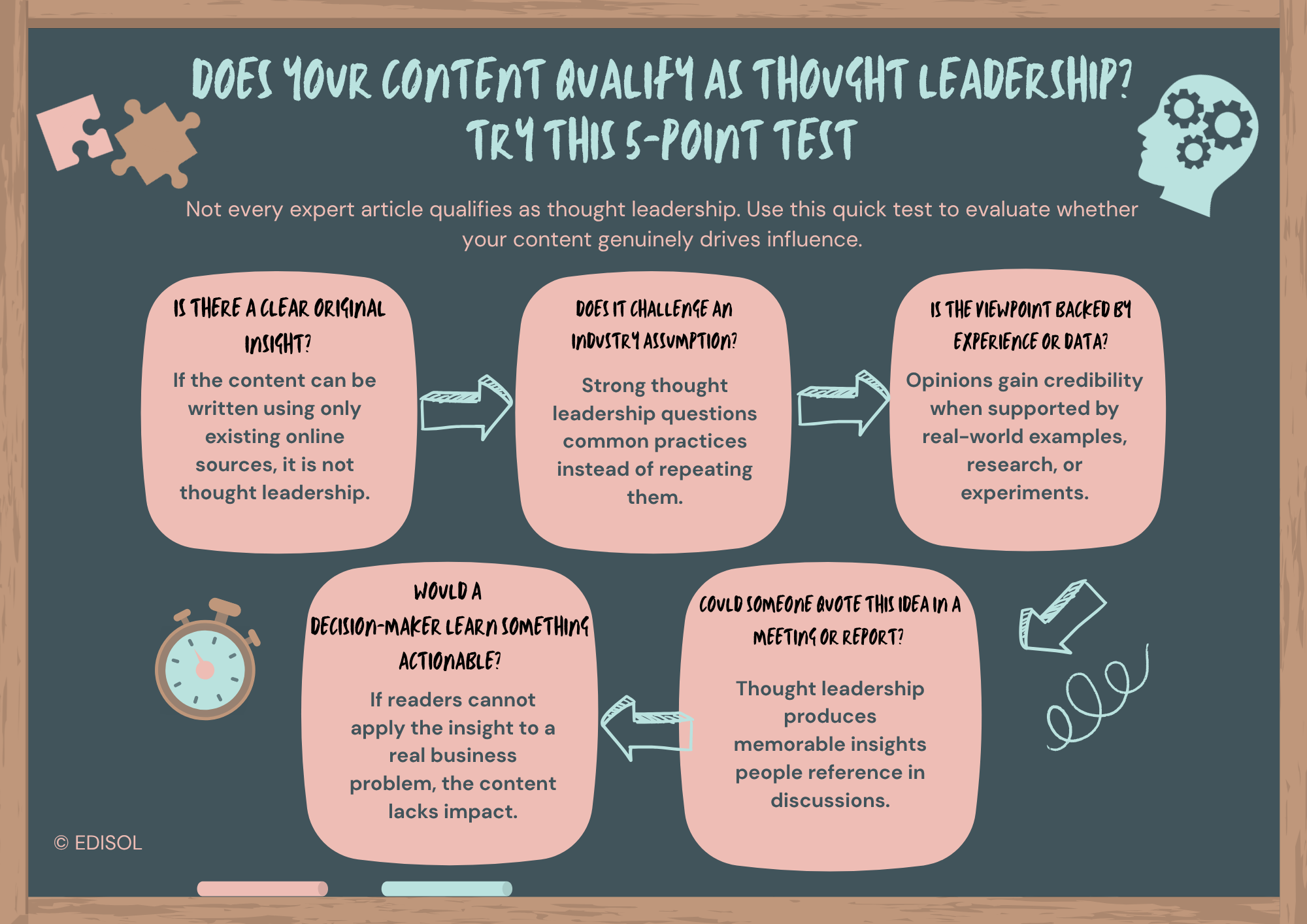
What Thought Leadership is Not: 3 Counterintuitive Signs
Any explanation of business thought leadership is incomplete without examining what it is not. And make no mistake, some elements should never be a part of any thought leadership strategy! In fact, these factors can make any efforts to establish authority futile.
General or Vague Content
To have convincing data or expertise that pushes readers into action, thought leadership content can’t be ambiguous. Being specific helps readers navigate the topic and its nuances better. The more specific the thought leadership content is, and the more simplified it is, the better it serves its purpose.
Here’s what Peter Economy, The Leadership Guy, at Inc. Magazine says: “Too often I see thought leadership content that is too technical, filled with jargon, or tries to cover too many ideas. The articles that leave a lasting impression are the ones that convey a powerful message simply and concisely.”
Many brands also don’t realise how poorly written content is hurting their business by weakening trust and diluting authority. Ensuring thought leadership content is free of grammatical or structural errors is key.
Being a Follower
In a time when thought leaders are increasingly common, standing out often means resorting to trendy practices. While such strategies may be common, relying on them too heavily undermines genuine thought leadership.
It is now usual to see repurposed content or ideas being used as thought leadership content with some additions. But this does not move the needle enough. To truly get the ball rolling, content must be unique, not recycled.
Just Theory
Business thought leadership can’t simply be theory or opinion. Content needs to be backed with substantial data and drawn from personal experience. This way, readers can better relate to the ideas and visions of the leader.
Simply put, a reader who knows how the leader formed an opinion is more likely to resonate with it and follow through. So, you can set your blog apart from your competitors’ by grounding ideas in real insight rather than generic statements.
An important aspect of thought leadership is having the right thought leadership branding ideology in place. Contrary to popular belief, corporate branding and personal branding are not mutually exclusive. They are interconnected and humanise the company while providing credibility to the leader. As a result, they need to go hand-in-hand in order to complement the efforts of a thought leader. Only then does thought leadership work to its full potential.
This arena of marketing is highly competitive and demands content that is not only capable of articulating the leader’s insights but also reflects their expertise. Explore how Edisol’s experience makes us uniquely equipped to create and execute a strategy that makes a lasting impact. Get in touch to build a thought leadership engine that drives credibility and growth.
Frequently Asked Questions
What are the key tenets of good business thought leadership?
Good thought leadership rests on four tenets. First, share genuine insights from experience. Second, avoid clickbait to maintain credibility. Third, express strong opinions to create tension and stand out. Fourth, commit consistently over time. These build lasting impact and inspire decision-makers.
What should you avoid in a thought leadership strategy?
Avoid three pitfalls: Don't use general or vague content. Instead, be clear and simple. Secondly, steer clear of following trends with recycled ideas. Originality matters. Thirdly, skip pure theory. Back your claims with data and experience.
How does personal experience strengthen business thought leadership?
Personal experience adds authenticity and uniqueness. It builds trust as readers see real-world roots. Insights from it provoke thought and drive action. Unlike generic posts, audiences can relate to it deeply.
Why is long-term consistency key to business thought leadership?
Consistency over time lets audiences grasp your vision. As Poshmark's CEO notes, steady messages build relatability. Plan extended campaigns, not seasonal pushes, for enduring branding and authority.
References
[4]https://www.orbitmedia.com/blog/what-is-thought-leadership-marketing/
[5]https://investors.poshmark.com/governance/executive-management/person-details/default.aspx


