SEO on YouTube now plays a big role in how people discover your brand. Search is no longer limited to typing keywords into Google and picking from a list of links. Today, people ask questions directly to AI tools, expect instant answers, and often prefer formats that explain things clearly, not just pages that match keywords.
This shift is also changing what kind of content gets discovered. When AI tools pull information for an answer, they often lean on video because it breaks down ideas faster and with more context.
That is why platforms like YouTube matter more than ever. It is no longer just a place to upload videos, but has become a serious discovery platform where people actively look for tutorials, reviews, explanations, and much more.
For brands, this means visibility is no longer only about ranking on Google. AI systems now influence what users see, trust, and engage with. And in this environment, YouTube optimisation (YouTube SEO) becomes a key part of broader platform optimisation. This is because it affects how YouTube and AI-driven systems understand, rank, and recommend your videos. Many brands miss this shift early, which is often why your content may be underperforming even when it seems ‘good’ on paper.
In fact, as per a recent report, YouTube accounts for 23.5% of AI-related search citations[1], showing how strongly video now influences what AI systems surface and trust. This is why YouTube optimisation now matters well beyond YouTube. It helps brands stay discoverable in a world where AI increasingly decides what gets surfaced and what gets ignored.
YouTube – a Default Search Habit
Ranking as the second most-visited website globally, YouTube processes billions of queries daily. Users seek everything from how-to tutorials and product reviews to in-depth explanations of complex topics.
This search functionality is powered by sophisticated algorithms that consider watch time, engagement, and relevance. This makes YouTube a go-to resource for people who want faster, clearer explanations than text results usually offer.
As of 2025, it boasts over 2.53 billion monthly active users[2], representing a significant portion of the global internet population.
Additionally, viewers consume more than 1 billion hours of video content every single day[3], underscoring its role not just as entertainment but as an informational hub. In an AI-driven search landscape, this positions YouTube as a critical player, with AI systems frequently pulling from its vast library to provide concise, video-based answers that align with user intent for quick and clear explanations.
YouTube’s Role in Cross-Platform Discovery
YouTube does not just help you get views. By optimising your video marketing, you can support content visibility across your website, Google results, social media, and even AI tools that people now use to search for answers.
Own Website and Structured Data
Your website is your most controllable asset, so it becomes the foundation for AI visibility. Add schema markup to help AI systems understand and cite your pages more accurately. Embedding or linking YouTube videos on relevant pages also strengthens multimodal visibility.
Google Search and AI Overviews
Google still dominates search with around 90% market share[4], which makes it central to any discovery strategy. This is why brands still invest heavily in navigating SEO in a world of constant Google algorithm updates, even as AI Overviews change what gets surfaced first.
To show up consistently, optimise for natural language queries where AI Overviews pull answers directly. This matters even more for video because YouTube dominates video citations, including 78% for product comparisons[5].
Social Media
Platforms like X and LinkedIn act like real-time trend trackers. They show what people are paying attention to. When a YouTube Short performs well, it can push discovery across platforms and indirectly improve visibility in AI search.
AI Assistants
ChatGPT often pulls video results from YouTube (via Bing), while Gemini uses YouTube for summaries. Additionally, Perplexity answers come with citations, and YouTube videos can appear among those sources.
What AI-Optimised YouTube Content Looks Like for Brands
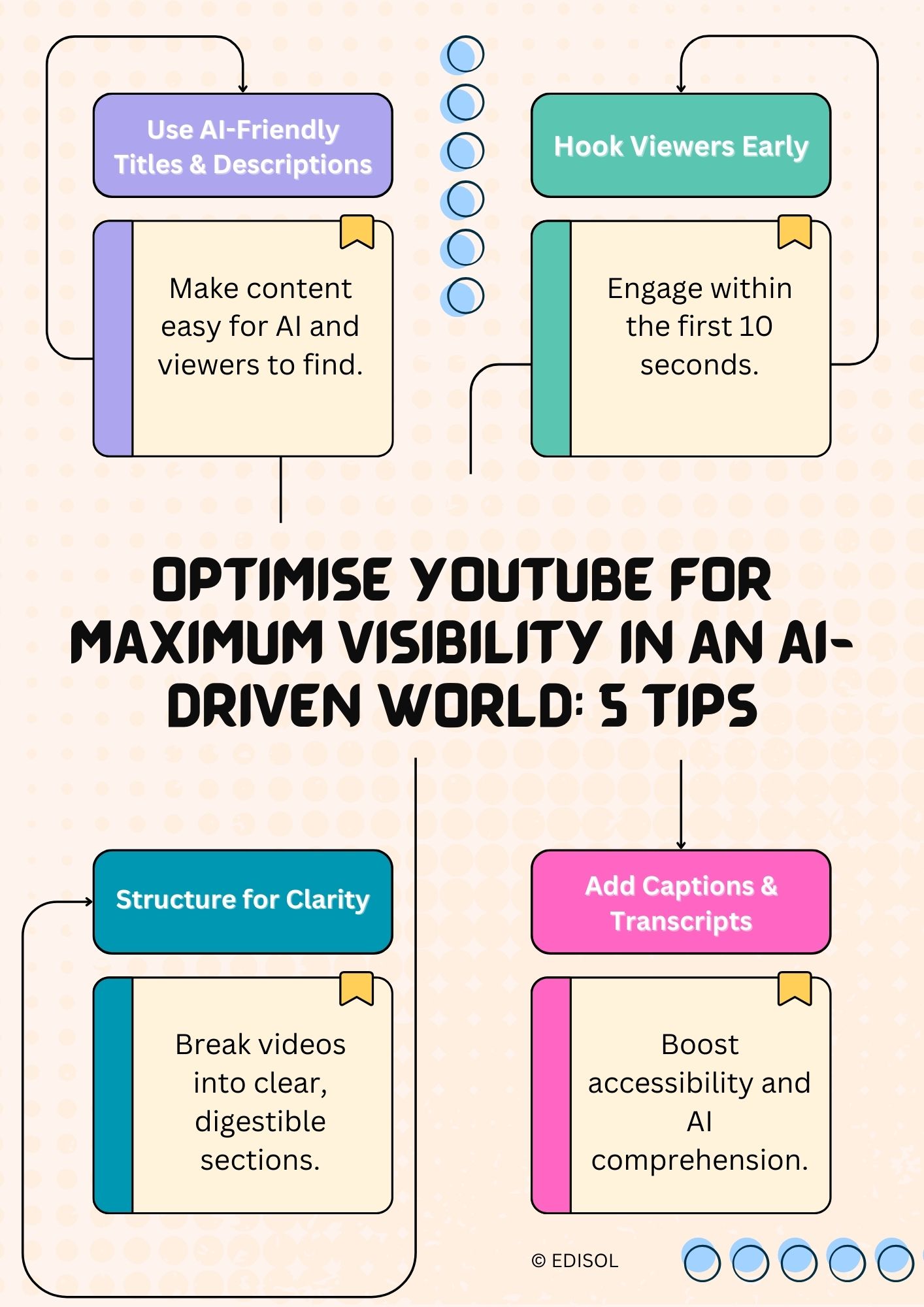
Optimising YouTube for visibility is not just about adding tags or chasing views anymore. For brands, it is about structuring videos in a way that AI systems can understand, trust, and surface when people search for answers.
This matters even more in environments like Google AI Overviews, where YouTube holds a reported 200x advantage over other platforms[6].
The shift is clear. Instead of basic optimisation tactics, brands now need a more complete approach focused on content quality, clarity, and credibility. In practice, this also means aligning with E-E-A-T (Experience, Expertise, Authoritativeness, Trustworthiness) and prioritising viewer satisfaction.
Intent-Driven Metadata
Use titles and descriptions that match how people actually search. Think query-style phrasing like “how to,” “best way to,” or “X vs Y.” Avoid leading with brand-heavy titles if it reduces relevance.
Structured Content Enhancements
Make your videos easier for AI systems to process. Add transcripts, chapters, subtitles, and structured elements like schema markup (where relevant). This improves machine readability and makes the content easier to summarise or cite.
Keyword Integration in Scripts
Do not rely on tags alone. For brands, the real optimisation advantage comes from including key terms naturally in the script so the video stays context-rich and query-aligned.
Authority and Engagement Signals
AI systems pay attention to trust and performance. Create content that reflects real expertise, keeps people watching, and earns engagement. Embedding videos across your site and other brand channels also strengthens credibility signals.
Optimised Descriptions
Descriptions should do more than repeat the title. Use a short, keyword-rich summary upfront, include timestamps, and keep sections structured so both users and AI systems can scan them quickly.
AI Tool Utilisation
Use AI tools to speed up execution, especially for generating title variants, description drafts, keywords, and chapter suggestions. The goal is not automation for its own sake, but efficiency without losing brand clarity.
Conclusion
YouTube optimisation is no longer just about improving rankings within the platform. As AI-driven discovery becomes the norm, brands need to treat YouTube as a serious visibility channel that supports search, credibility, and long-term authority.
With the right structure, metadata, and content strategy, your videos can stay discoverable, earn trust, and keep driving impact well beyond the publish date.
Building a YouTube strategy that is designed for AI visibility and cross-platform discovery? Edisol can help. Contact us to create content that strengthens your authority and keeps your brand discoverable across search engines, AI tools, and social platforms.
Frequently Asked Questions
What is SEO on YouTube?
YouTube SEO is optimising your videos so they rank higher in YouTube search and get recommended more often. It includes clear titles, relevant keywords, strong descriptions, and helpful structure, like captions or chapters. YouTube also looks at signals like clicks, watch time, and engagement to decide what to surface.
When done well, YouTube SEO helps brands get steady organic visibility even after the video has been live for weeks or months.
How can I improve my SEO on YouTube?
You can improve YouTube SEO by focusing on the elements that help YouTube and AI systems classify, rank, and recommend your videos:
- Use intent-driven titles (query-like, search-friendly)
- Write descriptions that explain without keyword-stuffing
- Maintain keyword and topic consistency across videos
- Add chapters, transcripts, and captions for indexability
- Embed keywords naturally in video scripts, not just tags
- Strengthen authority and engagement signals (watch time, embeds, trust)
- Use AI tools to speed up titles, descriptions, tags, and chapters
Is YouTube SEO easy?
YouTube SEO is easy to start, but it takes consistency to get right. Basics like clear titles, good descriptions, and relevant keywords are straightforward. The harder part is repeating it for every video and improving based on what works.
YouTube rewards videos that match what people are searching for and keep them watching. For brands, it works best when YouTube is treated like a long-term search channel, not just a posting platform.
What are the 4 types of SEO?
The four main types of SEO are:
- On-page SEO: Optimising content, keywords, headings, and internal links
- Off-page SEO: Building authority through backlinks and brand mentions
- Technical SEO: Improving crawlability, indexing, speed, and structured data
- Local SEO: Optimising for location-based searches like “near me” queries
Together, these help search engines understand your content and decide when it should show up to the right audience.
What is the 30-second rule on YouTube?
The 30-second rule means the first 30 seconds decide whether people stay or leave. If your intro is slow, unclear, or too promotional, viewers drop off, and YouTube stops pushing the video. Start with a strong hook, give quick context, and get to the value fast. Brands can skip long logos or company intros and jump straight into what the viewer came for.
References:
- https://timesofindia.indiatimes.com/technology/tech-news/google-slips-in-ai-search-race-reddit-takes-lead-with-share-of/articleshow/123449918.cms
- https://thesocialshepherd.com/blog/youtube-statistics
- https://www.oberlo.com/blog/youtube-statistics#:~:text=YouTube%20viewers%20watch%20over%201%20billion%20hours%20of%20videos%20on%20its%20platform%20every%20single%20day%20and%20are%20responsible%20for%20generating%20billions%20and%20billions%20of%20views.%C2%A0
- https://www.brightedge.com/resources/research-reports/brand-visibility-chatgpt-and-google-ai-approaches-industry#:~:text=90%25%20of%20global%20search%20market%20share
- https://www.godatafeed.com/blog/google-ai-overview-prefers-video#:~:text=YouTube%20citations%20appear%20in%2078%25%20of%20AI%20Overviews%20for%20product%20comparison%20searches
- https://www.singlegrain.com/search-everywhere-optimization/youtube-seo-in-the-ai-era-beyond-traditional-optimization/#:~:text=This%20200%2Dtimes%20advantage%20over%20the%20nearest%20competitor


